Saturday, 21 March 2015

Sad goodbyes

It is our last full day in Namibia and indeed being with my daughter, it will soon be back to Skype and WhatsApp… as they say, ‘every silver lining has a cloud’. I have tried with some success to keep the cloud out of mind, but it is getting more and more difficult. Still there is some lining left and the nine km hike through Khomas Hochland Hills remains un-hiked, by us at least.


Francolin, nicely camouflaged - Khomas Hochland Hills


We manage to rise and shine a little later than intended, eat a hurried breakfast, grab whatever bottles of water we can find, about 2 liters, and head out. Though it is still early in the morning it is already ominously warm, not the slightest of breezes troubles the air and not a single cloud drifts across the sky. The thought crosses my mind that this is the sort of day better suited to lazing next to swimming pools under canopies, sipping sweet cocktails with silly names like ‘Pink Nipples’, but we are here at the start of the trail and I am strictly a beer, wine and whisky guy anyway. It is a little over an hour later than I had wanted to start, but what the hell, nine km is not really a long distance, it is trivial. I have walked further than that in a shopping mall with my daughter, seeking the illusive perfect pair of jeans.

For some distance the trail is quite easy, it follows a dry river bed (it seems that dry river beds are the only type of river beds in this part of the world). We see lots of small bird life, it is still early enough for the birds to be out and about, as well as ostrich and a few warthogs before we stop for our first rest. I am hoping to see giraffe, oryx, red hartebeest, zebra, impala and kudu as well. I am hoping not to encounter hyena, buffalo, rhino, elephant, lions, leopards or any of the poisonous snake species that inhabit these parts. I have been led to believe that we are unlikely to encounter any really dangerous creatures here, except possibly snakes. This is black mamba country which is a pretty venomous creature and the fastest snake in Africa. I remember one Sunday morning, while serving in the South African Field Artillery in 1978 not all that far from here. Irrespective of religious affiliations, we conscripts had been gathered under a tree to listen to the Padre preach his stuff, when a black mamba slithered through the congregation. Well, a hand grenade could not have broken up the proceedings as effectively. I recall feeling a certain satisfaction at the serpent getting a tiny bit of his own back for all the centuries of slander at the hands of preachers like this one. Anyway, today I keep my eyes peeled for this sucker.


Follow the arrow... trees grow where ever they can


Delightful spider web


After a short rest we follow the trail upwards and the going gets a bit tougher as we get into the hills. It’s steep enough and challenging enough for your regular city slicker to feel a little like a Camel man, without having to actually suck on a cancer stick, but not tough enough to make the slicker regret doing the hike – ‘nice balance’, I think. The scenery is nothing short of magnificent once we reach a high enough point and get to look down on the valleys and sides of other hills. We even get a view of the city nestling in a valley far below. There are small groups of nervous zebra that run away when they notice us. These are not the usual plains zebra one finds in most game reserves in Southern Africa, I believe these are Hartmann’s Zebra, a vulnerable or possibly endangered species. It is fabulous to watch how they manage to pick their way, at a considerable speed, over rocky and steep terrain. We have a particular thrilling moment when we flush a baby (kid?) kudu resting in the shade of a stunted bush.


Baby Kudu flushed from the shade 


Mamma Kudu 


I realize that the kudu is doing the sensible thing and we are not. It is not midday yet, but the ditty ‘only mad dogs and Englishmen go out in the midday sun’, comes to mind.  We have been walking now for two hours, we are about half way, it is getting seriously hot and our inadequate water supply is nearly done. I should have known better, one litre of water each in this temperature is just not enough. The nine km is measured on a map from point A to point B and ignores the effect of elevation, if you flattened out the route it may be closer to 11 km and going up and down the hills is quite tiring. But we have passed the point that returning is further than pressing forward. The nice feeling of satisfaction, of intrepid Camel person has evaporated somewhat and a small sense of suffering is creeping into the picture. Still, the scenery makes up for the pain, that is, until the trail takes us down to (another) dry river bed and we have to do rock hopping. Now rock hopping wearing proper hiking boots is miserable, doing it with trainers is really nasty, but we persist, there is no other option. Our water is done and we still have about one third of the distance to do, and that includes another steep climb, it must now be very close to a murderous 40 degrees Celsius. I will spare you the full saga of the final climb, it is not pretty. After what seems like an age of short hops between shaded bits on the route we finally make it back to the lodge. Hallel-fucking-ujah. 


As I said, follow the arrows - the last climb is hell on earth 

 We had thought of doing lunch here, but neither of us have any appetite, just a raging thirst. There is a kiosk where we have parked the car that sell tins of fruit juice (Liquifruit), refrigerated to bitterly cold temperatures, at extortionist prices. I empty the wallet and buy... polishing off two cans right there and then.

On reflection the hike is one of the high points of the trip, and I can recommend it to anyone that is fit enough to walk twenty km on a city sidewalk. We saw plenty of wild life, albeit no giraffe which I particularly wanted to see. The best part of the game viewing experience was to feel like part of their world and not see them from the bubble of a vehicle. A little better planning on my part would have improved the experience, like taking enough water and starting off early enough so that we could cover more distance before it becomes too hot, and wearing decent hiking boots.

By the time we get back to Arebbusch we just want to sleep for a few hours, but I have another errand to run. The rented VW Polo is in dire need of a clean, it is encased in several layers of salt and sand and the interior has starting to look (and smell) a little like a cesspit. I have been warned of extra charges that will be levied against my Visa account in the event that I return her in this state. I am not a person that is in favour of extra charges on my Visa account, I am cheap in that regard. So I leave my daughter to sleep and drive towards the city centre, certain that I will find a car wash, which indeed I do. I’d thought that I would push the thing through one of those places with revolving brushes that squirt soap and water and then blow it all dry, perhaps spend another five minutes with a vacuum cleaner and be done. This, however, is not the way things work here. For the princely sum of fifty Nam Dollars (five US dollars) I leave the car in the care of a team of about five people that spend the better part of an hour hand washing and polishing the thing to within an inch of its life, inside and out. While I wait my appetite returns and I spot a Nando’s Portuguese Chicken franchise. I have a (hot) peri peri chicken quarter with chips and coleslaw and wash it down with a couple of bottles cold Tafel Lager, not the worst way to spend an hour.

When the cleaners are done, the car is indeed spotless, unbelievably so. I feel as guilty as sin and give the crew a tip of fifty Nam $. They seem to be ecstatic, which make me feel even worse. There is something to be said for cheap abundant labour, unless of course you are one of the cheap abundant labourers. We passed a settlement on the way to the Daan Viljoen Game Reserve where these cheap and abundant labourers live with their children in makeshift homes of corrugated sheet metal, cardboard and any other scrap materials they can find. Can you imagine how hot these houses must get when the mercury registers 38 degrees Celsius?  This is not news to me, I am familiar with these settlements and the poverty this is indicative of, it is the ugly side of Africa, probably the underlying reason why I left. It is here that life becomes cheap and violence can so easily become a way of life. I do not know the answer, I do not think there even is an answer. I do know that where some people own several luxury homes, drive several cars, have several servants and take several trips overseas every year and others eke out a living as cheap abundant labourers then the system stinks. The existence of billionaires and people dying for want of a meal on the same planet just does not seem right to me. The fact that George Clooney’s wedding cost several million dollars (to a human rights lawyer for Christ’s sake) while people live in shitholes like this bothers me... am I alone in this wilderness? Communism has demonstrated that it fails to produce a just and fair society, but has capitalism? Oh well, let’s move on, I can’t change the way of the world, merely comment on it, and in my own way I am as guilty as Clooney.


 Where the cheap, abundant laborers live 


The rest of the day we do the relaxing thing and just enjoy each other’s company, swimming pool (sans Pink Nipples cocktails)… salad and BBQ for dinner. Then getting everything packed up so that we can slip away early to get to the airport, my daughter’s flight is at the crack of dawn and mine is a little later. Goodbyes are never easy, and this one is tougher than most. I wish I had another few weeks to explore more of this incredible country with her, we have covered such a tiny piece of it, and she has grown to become such good company, but at the end of that there would still be a tough goodbye. It is the way of the world we have made.

Postscript:

As I write this I am sitting at my desk in Southern Ontario, looking out at the garden still covered in a few inches of slushy snow and ice, the aftermath of the coldest February on record in these parts. Spring is actually in the air, although the weather is still fairly miserable. Early spring is the ugliest time of year, mounds of dirty snow melting into muddy pools, leaving rubbish and petrified dog turds to litter the sidewalks, like some ghastly moraine.  Brown and grey are the dominant colours. The transformation that happens from this nastiness to the glorious summer never cease to amaze me, despite the 0 degrees Celsius (feels like -7), and some icy rain, I feel the process starting and my spirits lifting. In the mornings just before sunrise you can hear the first tentative strains of bird song, and the squawk of Canada geese returning home is unmistakable. The dachshunds, roly-poly from the winter, have already embraced the walkies season.  


Early spring in Southern Ontario, just beautiful , fucking beautiful. 


I know that I must not wish the days of my life away, but I can’t help longing for the moment that the weather is good enough to fetch the Boulevard from storage, and finally for when it’s hot and the forests turn to green and I can ride from sunrise to way after sunset. 

Sunday, 8 March 2015

Windhoek

Windhoek Airport was my entry point to Namibia, it is also the exit point, where we’ll be catching our respective flights to return home and to reality. Windhoek Airport is also the scene of a pivotal moment in my life, I alluded to it in the first post about this trip and I quote my words, “I am only a few kilometres from the spot where my mother lost her life 46 years ago when SA 228 crashed…”  Now this blog is about my travels, and not a tear jerker, nonetheless I cannot write about Windhoek without referencing this event. It was 1968, the day after my ninth birthday, Simon and Garfunkel’s Mrs Robinson was already getting airtime when we waved goodbye to my parents as they took off from the (then) Jan Smuts International Airport en route to Europe. I recall, without knowing a thing about the story, toasting my mum in my mind thinking, "Here's to you Mrs.Williams," not just anyone got to fly to Europe in those days. I have a clear picture in my mind of my mum, a bit overweight, but still very pretty, wearing a bottle green skirt and jacket, black blouse with pearl necklace, those were the days that you dressed up to fly. She hugged me then walking away through the doors that led to the departure lounge. I recall standing on a balcony and watched her as she climbed the steps to board the plane, I imagine that she turned and waved to me, it was the last time I saw her. I have no idea how much of these memories are actually true or simply confabulated, it does not matter, it is as I recall it.

The Boeing 707 made a stop at Windhoek, to refuel and take on more passengers before heading north to Luanda, Las Palmas, Frankfurt and finally Heathrow. However it didn’t get much further than the end of the runway, crashing minutes after takeoff killing almost all aboard, of the 128 passengers and crew only 5 survived. Wikipedia (where else) has a reasonable account of the incident, http://en.wikipedia.org/wiki/South_African_Airways_Flight_228. My father was one of the 5 survivors, he suffered severe physical injuries including temporary insanity and brain damage, which for the most part reversed and returned him to a more or less normal state within three years. He was, however, never quite the same person again. Perhaps it is a romantic thought that almost everything about me was determined in those few seconds, but I believe it actually is so… my sense of independence and distrust of religious doctrine and authority was forged in the furnace of that experience. For years afterwards my family referenced everything to pre or post the air cash. My sisters and I were extraordinarily lucky to have grandparents that were willing and able to step in and take charge, they effectively raised us, hence sparing us the awfulness of separation and foster care. Of course at the time I did not consider myself to be terribly lucky, and did not even think that my dear Gran and Gramps had the option of washing their hands of the whole problem. In retrospect I have no doubt that this must have been an attractive choice for them, they were old retired people and my grandfather was rather sick with stomach ulcers, yet they uprooted their lives and took on the task of raising us. THANK YOU GRANNY AND GRANDPA.

Today we are travelling on the same route to Windhoek that we came by, it is sad that we don’t take the more scenic road, the C 28 is definitely the way to go... I hanker, I want this road, but I know that it is too risky. My sister has a 1 p.m. flight and having suffered one flat tyre on just such a stretch of road, I realize that the adult thing to do is stick to the tar… damn. There is something I love about my travels on the Boulevard, I am alone and have only to consider one person, me. If I get lost it is only me that can bitch, if I choose a lousy road, it is only me that can be angry with me. However today I have passengers and I have no option, I must choose wisely, there is a plane to catch.


En-route to Windhoek  

The journey passes quickly, far too quickly. We pretend to be cheerful, but there is a melancholy atmosphere that none of us can dispel. Already I miss my sister and wonder when I will get to spend a decent chunk of time with her again. It’s a strange thing this South African diaspora, not the way we expected things to turn out. The desert turns to yellow grasslands and then to thorn bush and the hills surrounding Windhoek materialize. To get to the airport we have to cross through the city centre and witness some of the worst driving I have ever seen, but we make it there in time and without incident, even have time to spare to get some lunch before her flight. By this time we are all hungry, despite the delicious farewell breakfast provided by Tilla and Tula at the guest house. The little restaurant in the airport serves a tolerable lunch, but the complete lack of windows just adds to the general ‘down’ of the moment. The time comes for her to pass through the security portals and after a quick hug she is gone. I keep my tears in check, no good for an old guy like me to be seen crying, I’m old school, ‘cowboys don’t cry’. Still I wipe tear away before anyone can notice.


Lilac-breasted Roller - photographed at Arebbusch Travel Lodge

The big lump in my throat is still coming, when my daughter and I must say goodbye, but for now we have a few days left to enjoy each other’s company, and whatever Windhoek has to offer. The charms of Windhoek are more in the nature of the traditional expectations of a western person of an African experience, thorn tress, grasslands and African game, ala Karen Blixen… zebras, antelope, baboons, elephant, giraffe, leopards and lions. Not to mention game lodges, being called ‘bwana’ and bare breasted African maidens dancing, actually this last bit is not seen much anymore unless it’s staged for tour groups at much expense. The impact of television has some regrettable consequences and of course you would not hear the word ‘bwana’ 'round here except in sarcasm, they don’t speak Swahili in Namibia.

I had pre-booked and paid accommodation at the Arebbusch Travel Lodge from Canada, (the same place we stayed when we arrived in Namibia a few weeks back, see earlier post, http://www.not-so-easy-rider.blogspot.ca/2015/01/nam.html). I suppose that I lacked some imagination when I was doing the bookings, and should have tried somewhere else to make the experience a bit more interesting. Too late now, I have already parted with the brass, so to speak, and it’s really quite adequate, if a little bit too close to the City of Windhoek. Besides spending some quality time with my daughter and doing some game viewing, I want to see the southern hemisphere night sky at a sufficient distance from light and other pollution so that one can actually see the stars properly. Star gazing and game spotting, the ultimate of African experiences.


Pumba - Daan Viljoen Game reserve

Most of humanity seems to have forgotten, and some may never have seen the night sky as our forefathers, and I presume foremothers, witnessed it whenever weather permitted, as recently as 250 years ago. Before Edison, Henry Ford and the industrial revolution turned the stars into little twinkly things, like sequins glued to a canopy of black baize, flat and all equidistant from Earth.  If you can get to a place on a clear, moonless, night that has clean air and far enough from city lights, you will be rewarded by the grandest of vistas that you have ever seen, and if you can do this in the southern hemisphere all the better. You can then start to appreciate the fixation our ancestors had for stars, you can see the depth of heavens, see that some stars are closer than others even though they may be dimmer and the Milky Way is not just a smudge, but you can actually see that it is made up of stars uncountable. The planets become visible, Mars is orange and Venus does have phases just like the moon and the stars really are not the same colour, some are blue, some are white, there are yellows and even browns. It is the most humbling, yet most wonderful experience imaginable. There was a time in my life when I drove between Johannesburg and Cape Town and on a regular basis, about an 18 hour drive. Usually I managed to time it so at least some of the part of the trip that took me through the Karoo would be at night, (http://en.wikipedia.org/wiki/Karoo ). If I was lucky I would encounter the Karoo on a moonless night and stop next to the road, to lie on the roof of my Jeep wrapped in a blanket and stare up for an hour or so. I remember doing this with my daughter on one of those trips, it was a moment in my life I will not easily forget. Sometimes I am asked, how does a godless person like me find any meaning in life? Looking up into the cosmos I have realised that there is more meaning to be discovered than my meagre intellect could possibly manage over several life times.     

Google, as always, is my friend, though the internet connection at Arebbusch is not entirely as reliable and strong as I would like it to be. There are a few options to do some game spotting - game drives, guided hikes, and there are several unguided hikes available. I choose to do unguided hikes, game drives are very pleasant, but generally expensive and terribly touristy and guided hikes you need to book well in advance. The Google machine leads me to a small national reserve with the unlikely name of Daan Viljoen, a very Afrikaans name for a post-independence Namibia, http://www.namibian.org/travel/lodging/daan_viljoen.htm. It is an absolutely fabulous little place, even though it is only about 4000 hectares, not much more than a large farm in these parts, situated on the Khomas Hochland Hills, on the western side of Windhoek, overlooking the city.  They offer the intrepid traveler several hiking options from an easy-peasy three km, to a more challenging nine km and a guided 27 km trail. We decide on trying the 3 km as a prelude to dinner at their restaurant, the nine km route we plan to do early on one of the days that we are here.


 Interesting art at Daan Viljoen Game Reserve


We arrive at about 5 p.m. after losing fifteen minutes to an error of route selection (aka, I got lost because I took the wrong turn). There is a surprising amount of red tape involved and hidden fees, forms to fill with several carbon copies and so on, in order to finally park the car and take off into the wilderness. The 3 km hike is a 1.5 km walk along a dry river bed to a silted up dam, and back again. It is not terribly challenging, but still a decent hike with enough game to make it very worthwhile. We see gnus, including males fighting over breeding rights, warthogs and a troop of Chacma baboons, not to mention a good selection of bird species. My daughter even manages to be almost in the path of a small herd of gnus doing a little stampede. Being in close proximity to baboons is quite a spine tingling experience, though they are not usually aggressive if you don’t interfere with them in any way and you have no food with you. The big males are a study in primate strength, lean and muscular, almost like cartoon depictions of a body builder, huge shoulders and tiny waist, and armed with surprisingly large and lethal canine teeth. Though they weigh less than half I do, I would be utterly no match in a straight fight, not even when I was at my peak strength in my mid-twenties.


Small stampede of gnus 


Bit of male competition 


I think the game we managed to see, though not from the big five, isn’t bad for a short walk along a dry river bed, after all I would not like to encounter anything more dangerous than the animals we saw. Dinner at the restaurant is reasonably good, not quite as good as I had hoped for as the venison fillet (known in North America as ‘tender loin’) that I order tastes suspiciously like beef rump steak, nonetheless it is tasty and by this time we are pretty hungry. So all is well, there is a sunset, a few Scotches and soda, a full moon and the chance to spend time with my daughter. Shit, I realize, a full moon presents a problem to the star gazing ambition – full moon equals too much heavenly light to see the stars properly.


This graveyard was on the path we walked at Daan Viljoen 

The next day we just chill out at the lodge, my daughter swims in the pool, while I experiment with building a sundial using a water bottle, the tiles on the floor and my cell phone’s GPS. Adjusting for the actual longitude from the start of the time zone, I manage to get the shadow of the water bottle sundial to show the time to within only a negligible error. I am such a nerd. It is now midday, very close to the summer solstice and a hair north of the Tropic of Capricorn, time to get out of the pool and the sun and head to the air conditioned sanctuary of the bungalow. I braai (otherwise known as BBQ) lamb chops and my daughter makes salad for lunch. It’s a wonderful feeling not having to do anything for the afternoon, a rare luxury for me, but I seem incapable of taking advantage of it. I don’t know when it happened, but somewhere along the way I have unlearned the ability to just relax.  

I have worked out that even though the phase of the moon is just past full, there might be a very brief window for us to see the night sky in all its glory between sunset and moonrise. Late afternoon we head out, south towards Rehoboth on the B1 in order to get some distance from the city lights. The sun dips below the horizon in a fabulous display of pinks, oranges and finally purples, we turn onto a side road and find a place to stop. I am disappointed as there seems to be a glow on the eastern horizon, perhaps the lights of a town I wasn’t aware of. Nonetheless the sky darkens and the stars start to reveal themselves. There is a very brief moment when I get a glimpse of the night sky I am looking for, it is only visible over a patch of sky above us, and then the glow on the eastern horizon gets brighter and expands across the sky. It’s not light from an unknown town, but the moon itself, from just a sliver of bright silver on the horizon to a shiny full disk takes mere moments. The moon may have robbed us of the stars, but this is one of the most magnificent moonrises I have seen. The land is flat bushveldt with a few mountains in the distance, it’s a cliché, I know, but no other way of saying it, the world is bathed in a silver light, it is breathtaking. The absence of pollution and even moisture in the air, I speculate, produces this clarity of light.


The drive back to Windhoek is in silence, I am not sure if it’s the moonrise or the realization that we have just two nights left and only one full day, perhaps both. In any event it’s to be early to bed. Tomorrow we will do the nine Km hike, and to avoid walking in the midday sun in 38 Celsius we’d better be up early.  

Monday, 16 February 2015

Skeleton Coast

Happily the tyre incident is easily resolved and at no great expense, I suspect the same damage in Canada would have been a lot more of a costly affair. Note that due to the international mix of my readers I am using the English spelling for ‘tyre’, (always wanted to write something like that). The guy at the tyre fitment place is friendly, young, white and Afrikaans and assures me that there is no need to replace the rim, they will bash it out with a hammer. I notice that the people actually doing the work are black, it strikes me that not all that much has changed, Apartheid is alive and well and living in Namibia.  While the workers do, the ‘boss’ and I chat and I find out that the old Walvis Bay army barracks has been demolished and is now a golf course, complete with swanky golf housing estate - a pretty good use for any military base in my view. Anyway, in about forty five minutes and for just over US$70, the spare wheel is back in its hidey-hole, and we have a new tyre, wheel is balanced, rim repaired, and the plastic hubcap is held in place with two new cable ties. I feel confident that the trip north, up the Skeleton Coast is within the gifts of the VW Polo, I have been led to believe that the road is mostly a salt road and not nearly as bad as the road to Solitaire…I guess time will tell, the folks around here have much lower standards when it comes to road conditions than I am used to.


First stop is Swakopmund. This is a pretty little town, more genteel and touristy than Walvis Bay. Walvis Bay is grittier, the ugly sister, but I find that I like it better, it’s less crowded and has more variety to offer. We have already spent some time in Swakopmund, I have written about our Christmas Eve meal in the Chinese restaurant at the Mermaid Casino. We have also walked on the pier and beach and failed to find a place to eat lunch as it is so full of tourists, in the end we found somewhere that served the smallest croissant I have ever seen and if my sister is to be believed, one of the best slices of cheese cake ever. Today we are going to stop in at the museum. The museum is privately funded and privately run, the brainchild of a local dentist, opened in 1951. My sister wants to see the place, I am not expecting much, ten minutes to review a few desultory exhibits and we’ll be on our way.


Swakopmund


 The world's smallest croissant

We park a few blocks away and immediately get harassed by a ‘car guard’ cum purveyor of kitsch leather and palm nut bead necklaces. Now I know that the guy is just trying to make a very modest living in very difficult circumstances, but this car guard thing is just a scam. You cannot park your car in any free parking lot in Southern Africa without being obligated to pay some money to a guy who will supposedly look after your car. That’s ok you may say, it’s your choice to pay or not, but it’s a protection racket of sorts, the hidden message is that if you don’t pay, the car guard may turn car vandal or perhaps thief. This particular car guard has an additional angle. ‘What’s your name?’ he asks innocently, when informed he whips out a little blade and starts to carve my name onto the palm nut bead of one of his necklacey things, so attempting to obligate me to buy the piece of crap.  But I am not a real overseas tourist, I grew up in Africa and am wise to the ways of car guards. I give him NAM$ 5.00 to pretend to look after the car, but firmly (and politely) advise him that even if he carves my name onto the nut, I will not be parting with any brass for the object, and then he will have a hell-of-a-job selling it to some other sucker with my name on it. There is, sadly, no market for palm nut beads and leather necklaces with my name carved, perhaps sometime in the future, but nothing right now.

The museum, however, is no scam, what a totally stunning little place! It is of course not the V & A in London, but it has a superb collection of all sorts of stuff from taxidermy, to military, to currency, to geology, dentistry (in honour of the founder), demographics, vehicles, farm implements and so on all relevant to Nambia, well exhibited, intelligently documented and very informative. There is a nice section on WW 1, when South African under Jan Smuts invaded Namibia (then known as German West Africa) in support of Great Britain. There is much bleating about how a 60,000 strong South African Army defeated the gallant German garrison that numbered a mere 6,000. I guess that this must have rankled especially as Germany was the chief supported of the Boers in the Anglo Boer war a mere twelve years before, and General Jan Smuts had been one of the Boer generals that fought the British with German supplied Mauser rifles and ammunition.


Inside Swakopmund Museum

Another exhibit I particularly enjoyed was about the population of Namibia.  About half of the 2 odd million population are Ovambo, the rest are Kavango, Damara, Herero, White (mostly German and Afrikaans), Nama, Coloured, Caprivian, San, Basters and Tswana and now a smattering of Chinese.  The Chinese are a recent arrival, the Walvis Bay harbour expansion project was awarded to a Chinese company so as a result both Swakopmond and Walvis Bay have a quite a number of Chinese. The Ovambo people, although of the Bantu group, tend to have a different look, they are very dark, really ebony, finer features often thin and wiry, a little like the Maasai of Kenya, very attractive people. Of course I have not been here long enough to pick up any underlying tensions but it seems to me that this diverse group get along fairly well, probably because the Ovambo are a significant majority. There is still the great divide between whites and blacks (you could almost say between haves and have-nots), as mentioned earlier, apartheid is not dead over here. The Basters are an interesting group, the word itself means hybrid or mixed breed, actually also mean bastards. These people were descendants of slaves and Dutch masters from the Cape Colony that trekked to the Rehoboth area in ox wagons in 1868, hoping to establish a free republic for themselves, apparently a popular thing to do at that time and who could blame them, colonial repression and naked racism were the order of the day.  

The San or ‘Bushmen’ people are also an interesting bunch, though I cannot say that I have actually met one. My knowledge of them is confined to Laurence van der Post books and Jamie Uys movies ‘The Gods Must be Crazy’ I and II, which is probably as far from the truth as is possible. I have a romanticized idea in my mind that they are the absolute epitome of the noble savage.  Nonetheless they are a real example of hunter gatherers, perhaps what all humanity looked like seventy thousand years ago. They have a tragic recent history, I guess they lived in peace and prosperity for many thousands of years in Southern Africa until the Bantu people started to move down from central Africa three thousand years ago. This was the clash between herders/agriculturists and hunter gatherers in Africa and it probably was not very nice. By the time that the ultimate bastards arrived on the scene, the white people, the San were already marginalized. Of course the white people industrialized the process and hunted San people as if they were vermin, actually offering a reward for each one killed. Today less than 100 000 of them remain, living mostly in the Namib and Kalahari deserts that cover parts of Namibia, Botswana and South Africa, many of them still live in immediate return hunter gatherer societies, a magnet for anthropologists.

After the museum excursion, we head north towards Henties Bay, legendary fishing town. If you live in Southern Africa and like to stand on the shore with a pole in your hands (I mean a fishing pole!) then Henties is the Mecca that you dream of, the pilgrimage that must be made.  Actually as soon as we have left the municipal area of Swakopmund there are signposts for ‘Mile 14 Fishing Area’, ‘Mile 15 Fishing Area’ or ‘Hobom’s Gat Fishing area’ and so on. If you follow these exits to the coast you will find a few trucks parked and guys standing on the beach (which stretches as far as the eye can see north and south) with fishing poles in their hands. On the road, which so far isn’t bad at all, we see many vehicles with fishing poles stuck into brackets attached to the front bumper, giving them the appearance of an insect with long feelers.


Wreck Fishing Area with actual shipwreck


See some of these around, looks like a good way to tour here

I am not entirely sure why this is called the Skeleton coat, there are a few theories, perhaps the most correct one is that it is a treacherous coast line that enticed many ships to run aground resulting in many skeletons of men and ships littering the shore. We see only one ship wreck at what is now called “Wreck Fishing Area” so I am not sure that the theory is correct.

About half way to Henties Bay we encounter a very odd looking village, Wlotzkasbaken, ‘baken’ means ‘beacon’, and the rest is named after a surveyor called Paul Wlotzka. It is a weirdly, wonderful, surreal place, it does not resemble anything I have ever encountered before, actually makes Solitaire look completely normal. It is a settlement of holiday homes (apartheid is also alive and well here, there are no non-white owners of homes in Wlotzkasbaken). Still it is a very colourful place, each of these buildings is individualistic designed, some very eccentric, they all fly a flag of some sort, generate their own electricity or use some other energy source and all water is trucked in so each house has a mini water tower. In the holiday season several hundred people inhabit the place, no doubt avid anglers, out of season there are only a few retirees… it looks like a good life. I am reminded a little of Advocate Harbour on the Bay of Fundy in Nova Scotia, without the fucking freezing winters, and Germans instead of Scots.


Some houses from Wlotzkasbaken, see flags and water towers 

Henties Bay disappoints a little, but as none us know the difference between a hook and sinker, this is not really surprising. Okay I admit, I know that hooks are made of steel and sinkers of lead, but I have no clue when it comes to the real lore of this sport. My grandfather was seeped in it, and had handmade rods, hand-tied flies, made his own lures, sinkers and god knows what else, all in the pursuit of silvery scaly creatures. In this respect I am an ignoramus, I admit that I just don’t get it, you either are a fisherman, or you are not. I am not, period.  There is some festival on the go on the beach, we avoid it but mange to walk a bit on the beach, actually it seems that the Skeleton Coast is one very long beach, miles and miles of yellow sand, and apparently miles and miles of blokes with poles in their hands. The water is very cold, this would surprise you if you hadn’t studied Grade 4 geography as a child in South Africa (and Grade 5 and Grade 6), where we learned, ad-nauseam, about the cold Benguela Current that flows up the West coast of Africa from the Antarctic. The bit they didn’t teach us is that this is part of the great system of currents that distributes the warmth from the equator to the north and south, making our planet habitable, currently in danger of collapse thanks to the effects of global warming. Henties Bay itself is full, and my aversion for crowded places kicks in. The interesting looking little fish and seafood restaurant we wanted to have lunch in is overflowing and there is queue (line-up), but a little driving around yields an establishment that has a few open tables…hamburgers instead of seafood. Service is slow, but the final result is at least edible, if somewhat boring.


 Beach at Henties Bay 

Without a firm idea of how far we are going to go, but with the idea that we will at least reach Cape Cross before turning around, we follow the road north. So far the road has indeed been in good nick, salt not tar, but we are able to go a decent speed. It is quite busy and the 4x4s and pickup trucks that dwarf the Polo, have little respect for speed limits. There are no towns to the north, so it seems that the majority of the traffic is generated by sport anglers and some tourists.

I am guessing, but I would imagine that this area must be fascinating from a geological point of view. There are yellow dunes, red dunes, rock formations, and even ranges of structures that look like dunes and black hills that have collided. We stop and spend some time walking and get to see the lichen on the rocks. From the road you can’t see them, but up close they are spectacularly beautiful. As I’ve said before about this desert, no matter how barren it looks there is always life. I believe that the lichen are sensitive to pollution and the effects of off-road driving. I have noticed many signs prohibiting off-road driving, but still the desert is covered with tracks made by thousands of vehicles, driven by thousands of idiots ignoring the rules. The day might yet come that we manage to destroy even this ecosystem, this oldest desert on earth.


One of the many species of lichen


When dune meets Black Hills 


Interesting geology, but notice all the car tracks 

We take the exit to Cape Cross. This is the site of one of the earliest European incursions to this area, the Portuguese looking for a sea route to the Spice Islands of the East. Diogo Cão, planted a carved stone cross here before high tailing it back to Portugal. The inscription on the cross reads, ‘In the year 6685 after the creation of the world and 1485 after the birth of Christ, the brilliant, far-sighted King John II of Portugal ordered Diogo Cão, knight of his court, to discover this land and to erect this padrão here.’  Wow, a major piece of brown-nosing if ever I saw one. The Germans, four centuries later, in the tradition of the age to pillage cultural and historical artifacts, uprooted the thing and took it to Berlin where I presume it can still be seen. There are two replicas of the cross on the site, neither of which I am terribly interested in actually seeing, for me it’s the real thing or nothing. Like the Elgin Marbles, this cross should be returned.

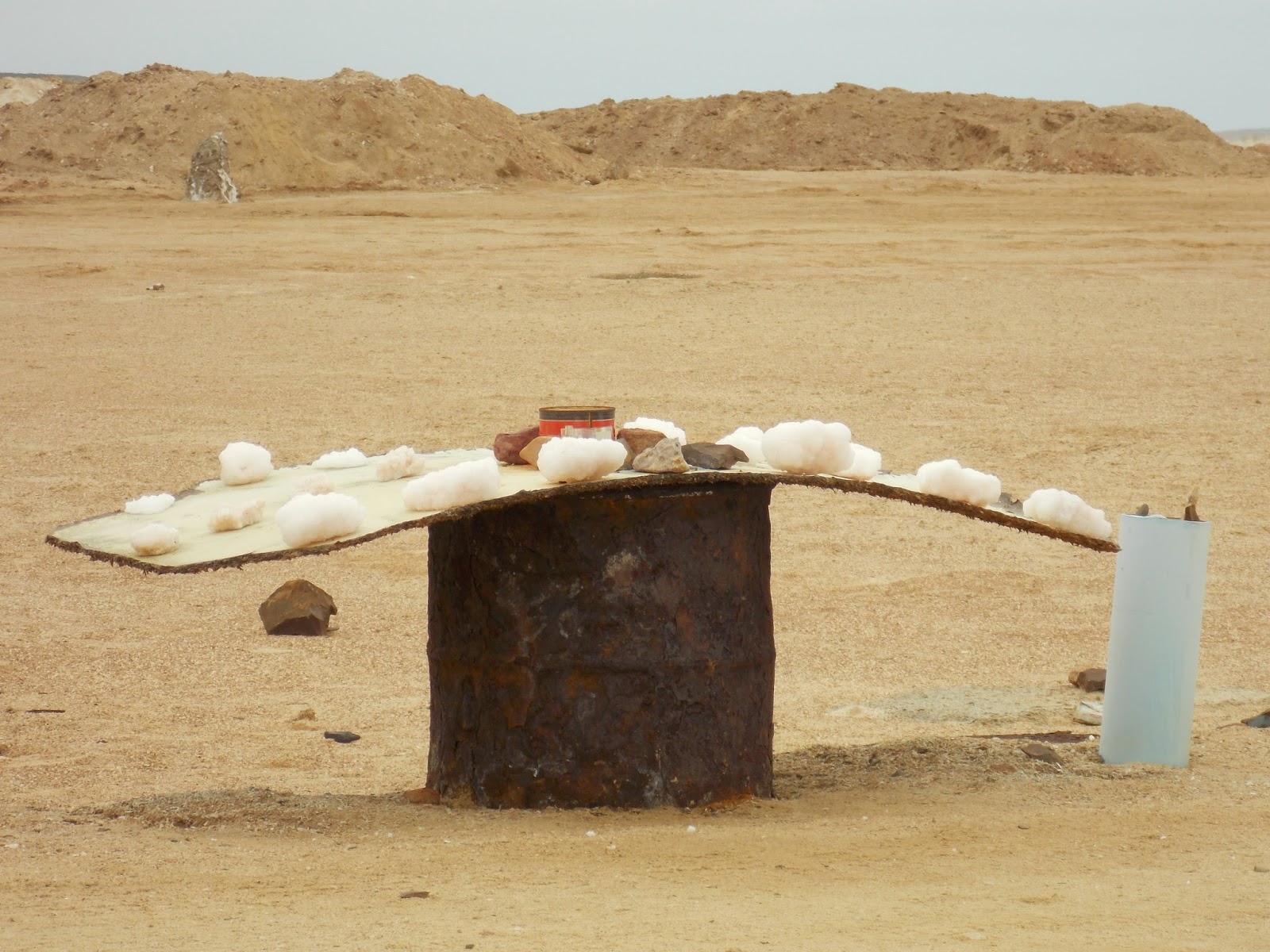
On the road to the Cape we pass many makeshift tables with lumps of white rock which turn out to be salt crystals. Apparently you can put some cash into a tin on the table and take a lump. Wow, I am impressed that such a system can still operate here, in Cape Town shortly before I left I had to replace the brass street numbers on the house with plastic ones as these had been stolen. Tula was telling me that they have the same issue in Walvis Bay, I guess there is a difference between isolated country districts and cities, here the same as anywhere else. Anyway, we shell out some cash to buy permits to enter the Cape Cross conservation area, which is less about fake Portuguese crosses and more about an enormous Cape Fur Seal colony. The Colony has inhabited this spot for thousands of years, despite a fair amount of baby seal clubbing that used to go on here.


Salt for Sale

This is an experience that takes your breath away and involves at least three of the senses. The first thing that gets you is the stench, even before you get close it is overwhelming, like a billion rotting sardines, it’s so bad you could cut it with a knife. We steel ourselves and approach, fortunately the olfactory sense adapts very quickly and a pervasive smell is quickly ignored by our brains (hence the ability to take a dump without being totally grossed out). An elevated and railed board-walk has been built so that visitors can walk, almost, amongst the seals. The noise is as overwhelming as the smell, a cacophony like I have not heard before. The males argue over territory with voices of Wookies (I guess it may actually be that Wookies copied male Cape fur seals) and there are tens of thousands of them. The liquid eyed pups bleat like lambs and there are tens of thousands of these too. I am not sure what sounds the adult females make, they are just totally drowned out by noisy demands of the men and children (sounds familiar?). Then there is the spectacle of literally wall-to-wall seals north and south and swimming in the ocean, as far as the eye can see, makes a Cape Town beach on Boxing Day look unoccupied. After the quiet of the desert this explosion of life is surprising, but there is death here too, no doubt adding to the stink are hundreds of dead pups, their corpses rotting and being scavenged by seagulls. I have no idea why this is place is the home to this colony, I assume there must be some inexhaustible supply of fish, or protection from predation. Anyway, definitely worth a visit, the price of the permit and enduring the smell.


Cape Fur Seals at Cape Cross


Cape Fur Seal pup

We don’t go very much further north, it’s getting late and we need to get back, our time in Walvis Bay is coming to an end, we will be heading back to Windhoek and a more traditional African experience.      


 Sunset over the Atlantic

Tuesday, 10 February 2015

Solitaire

We leave the guesthouse early, after a slap-up breakfast served by Tula, it’s going to be a big day. As we set out for Solitaire we know nothing about it other than the name, which is, you must admit, rather intriguing. My sister has brought a deck of cards so that she can play solitaire in Solitaire. Actually it is not our intended end destination, merely a stop on the way to the Sossusvlei area, where I fancy to see the red dunes of the Namib Desert. But first I have a date with an old adversary, a score to settle, a mountain to climb. The road takes us past one of the most famous dunes in the world. Just a few kilometres from Walvis Bay, the first dune in the range of mountain sized dunes that runs parallel to the coast from Walvis Bay to Swakopmund, Dune 7.  Even now, though nearly four decades have passed since it was a factor in my life, a small shiver runs down my spine at the mere mention of its name. BTW the origin of the name is rather obtuse - apparently it's the seventh dune past some or other bone dry river.


Dune 7 is reputed to be the highest dune in the world, it is 1,256-foot high and rises from the desert floor at an angle of 45 degrees on the front end. It was the mother of all instruments of torture in the hands of a sadistically inclined warrant officer, a day spent on the dune was a day spent in hell. Those days started off with a ten kilometre on-the-double march from our base at Rooikop, wearing fatigues, boots, steel helmet, light webbing, rucksack filled with spare clothing and sleeping bag, three full water bottles and rifle (otherwise known as 'full kit'). Once at the dune we played a game called ‘whistle, whistle’. The sergeant blows a whistle and we would go up the dune, blows again and back down we go, blows again and up we go, and so on... all bloody day long. The most demoralizing thing is that you don’t get to reach the top, the bastard always whistles you down before you could get any sense of achievement.


I recall our last excursion to Dune 7, we were coming to the end of our period of conscription and had reached a point of defiance that allowed us to finally achieve mastery over the dune, well a pathetic sort of mastery anyway. When the Sergeant blew his whistle to call us down, we just carried on climbing, and the stuff in our rucksacks wasn’t all that regulation shit, this time we had packed beer, not cold beer I grant you, but beer nonetheless. We dug our rifles in the sand, an act of sacrilege, to help us climb. When we reached the top, we sat on the crown of the dune, drank beer and shouted obscenities at the sergeants below, steadily turning purple with impotent rage. They threatened to charge us with mutiny, but we knew that it was just bluff, we were ‘ou manne met min dae’ (old hands with few days left), fuck ‘em we were untouchable. From that point on our daily routine was to get loaded onto trucks after breakfast and dropped 30 km into the desert, if we made it  back in time for lunch, then we ate lunch, if not, we ate supper. I don’t think I ever managed to get to eat lunch, but that didn’t really bother me, I was totally okay with the whole thing, best few weeks of the entire two years of service.  


View from the top of Dune 7

Today I face a slightly different Dune 7, it is scarred by the virus of humanity, litter on the dune and at the base, planted palm trees and concrete picnic tables, more litter and overflowing rubbish bins where the sergeants had once stood. Still it remains a magnificent sight, there is something pure about it, clean like a mountain stream, a pillar of wisdom, despite our efforts we have not managed to befoul it... it is just too big. Barefoot, my daughter and I start to climb, no whistles to summon me down I move steadily up the dune, two steps up, slide down one-and-a-half. Though it’s still cool in the relatively early morning I am sweating profusely, this is hard work! But I am in the company of youth and failure is not an option, onwards and upwards, I arrive at the top well ahead of the youth, but only moments ahead of an elderly grandma that started to climb more or less at the same time I did. What a sight, I know how Lawrence (of Arabia fame) must have felt, marvelous. Getting down is a lot more fun and accomplished so much quicker than the ascent, you bound down with strides like a giant, comfortable in the knowledge that if you fall it’s merely into the soft yielding arms of the dune.


Agent Smith had it right, we humans are a virus, a disease, a cancer of this planet.


Youthful feet 'hanging' over the edge of the dune

Sand clings to my skin and occupies the more private creases of the nether regions a little more than I had expected, but this must be ignored and endured, we are not going back to the guesthouse for a shower. We bid Dune 7 a fond farewell and head for the famous red dunes of Sossusvlei a few hundred kilometres south of Solitaire. We take the C14, it is one of the main routes of Namibia, but only careful scrutiny of the map reveals the truth about this road, it is paved for a very short distance. We pass Walvis Bay Airport, which in my day was a military airport, the turnoff to Rooikop and then the pavement ends and its gravel. It’s not too bad, but the pace must by necessity slow. I don’t say anything, but I already have doubts about reaching Sossusvlei, such an expedition, I suspect, needs more vehicle than the VW Polo and probably an overnight stay. When you are used to travelling on good paved roads, maps can be misleading.


Sossusvlei didn't seem that far

Of course, I remind myself, this is not one iota about the destination and all about the journey. The conversation is great and the scenery is even better. The road to Perdition may well be paved with good intentions, but the road to Solitaire is unpaved and lined with the most incredible scenery imaginable. I suspect though, that walking this route would be pure hell. As the morning wears on it gets hotter and, if possible, dryer. I know that there is life a plenty here, now and again catch a glimpse of some green desert plant, when I stop to take a pee I spot a lizard and get harassed by a persistent fly, but how these creatures live and where they get any moisture from is beyond my imagination. Closer to the coast there is the fog that rolls in almost every night, but here it’s about as dry as it gets.


It's pretty darn dry here, but there is still life


We stop to view Vogelfederberg, it means Bird Feather Mountain in English, and with a bit of imagination I can indeed see it in this interesting rock formation, though it is not a mountain by any means. We’d like to get a bit closer, but there are signs telling us that we require a permit to do so. We hadn’t known that we would need permits, and this seems to be the case of many such attractions - we are actually in a nature reserve. Law abiding folk that we are, we turn around and head back towards the road. One can in any event not tarry at every point of interest along the way.


Bird Feather Mountain 

Kuiseb Pass is something to be seen, utterly out of this world, but somewhat treacherous, the road has deteriorated substantially by this point and doing much over 60 Km/h is not safe.  It is clear to us that reaching Sossusvlei is definitely not on the cards, even Solitaire is going to be a bit of a stretch. Normally on a trip I budget for about 100 Km progress every hour, which allows for coffee, brief meal and pee stops, today we are barely making 50 km for every hour, and there are no places to get coffee or take a pee in anything other than el fresco conditions, of course the entire desert is one huge lavatory if you are that way inclined. The C26 exists to the left, which would take you to Windhoek, indeed the shortest route between Walvis Bay and Windhoek, but the road is definitely not for the faint hearted. By now I am becoming concerned about getting my deposit back from Avis, horrible noises as rocks shoot up from the tyres and crash into the under carriage are no longer occasional occurrences. On the rare event of encountering a vehicle travelling from the opposite direction the hail of pebbles we go through is enough to make me shit myself.


Kuiseb Pass  

The topography is changing, now and then there are trees, though some of these are of the Naboom type, I guess this translates to ‘almost tree’, the Naboom is a cactus like plant that has the appearance of a tree.  There are also real trees, especially flanking dry river beds and more often than not these trees carry massive nests built by colonies of certain weaver birds. It is said that these nests are always built on the on the western side of the tree, giving a lost traveler the ability to take a bearing and so find the way home. Personally I think that if you are lost in this area, presumably without water, and taking bearings from nests in trees, you are pretty much fucked and might as well lie down and expire gracefully.


Weaver nests ...more or less on the western side 

We go through another pass as lovely as Kuiseb and cross the Gaub River, not a single drop of water flows of course, but otherwise utterly gorgeous. It is by now well past lunch time and hunger gnaws at the entrails. Solitaire seems to be elusively far away and a sign post invites us to stop at a guest farm and enjoy lunch and a beer, I am all for it, but my sister points ahead, Solitaire or bust…damn. The road is dreadful with lots of corrugated stretches that make your teeth chatter and by now I am convinced that my deposit is long expensed, but Solitaire finally arrives, or I guess more correctly stated, we arrive in Solitaire. Big surprise, this is not your usual one horse town.


 Baby Boom?

The place is actually not very old, in 1948 it was just a two room cottage on a newly established karakul sheep farm. Now it has a lodge, general dealer, bakery, gas station and restaurant, and a small settlement that houses the people that work in the afore mentioned. Solitaire gained some international fame through the book, Solitaire, written by Ton van der Lee. Ton described his experience of living there in 1996 with a character called ‘Moose McGregor’, whose real name was Peter Cross. Moose apparently was a master baker, and baked an apple crumble that supposedly attracted people to cross miles of desert to visit the place. I’m not sure if it’s the pie, the trip itself, the place or Moose himself that drew the visitors, though Moose now occupies a grave right in front of the lodge, he died in 2014. The restaurant serves a decent meal, and provides a reasonably cool retreat from the heat, though it is no more than a large thatched shelter, open on all sides. There are birds that run around on the floor seeking to grab any morsel that may fall from a table. I order an Onyx hamburger with salad, it’s really good and very filling so I don’t try the apple crumble, obviously not baked by Moose, but at least by Moose trained bakers. I do however order two slices of pie ‘to go’. This turns out to be two very generous portions, complete meals in themselves. Despite the isolation of the settlement, it is after all called Solitaire, the restaurant is quite full, and a tourist bus arrives in the middle of lunch to fill up the empty spaces. English is not the language of choice here, it is German.


Moose's bakery and confidence booster


There is a collection of these in Solitaire


These are the guys that run around on the floor in the restaurant

Namibia is infested with German tourists, which is great for Namibia, and I don’t mind them one little bit, they are well mannered, mind their own business and if you do open a conversation they are friendly and polite. I do just that now, there are a group of them at a nearby table that are obviously motorcyclists by the kit they have with them. I spotted their machines outside the restaurant, Austrian KTM 660s, I recognized these from one of the motorcycle rental places websites. I admit that I am GREEN with envy. It’s a mixed group of men and women, more or less my age. We chat for a bit, they are from somewhere in Bavaria and like me have to put their bikes away for nearly half of every year. We mutter a bit on that sad fact. I see that they have mesh jackets, gloves, mesh trousers, boots and motocross type helmets. ‘Hot?’ I ask and they affirm, the afternoons are 'difficult' they say in that peculiar, understated, German way. I can just imagine, it is 38 Celsius, windy and dusty, but wearing any less protective gear would be pretty stupid in this terrain. They are drinking large glasses of Coke – I presume that dehydration is a real danger, potentially lethal. It’s great to be with my sister and daughter out here in a VW Polo and I wouldn't swap this holiday for anything, but I think that I would also love to do a few days with these guys, heat, dust and all.


 KTM 660s


It’s almost 4 p.m. when we head on back to Walvis Bay. We did get to see a few red dunes on the way, small ones that will have to satisfy my red dune need. Soussevlei and Big Daddy, a 325 metre high dune, will have to wait for some other time, probably never I suppose. Oh well, you win some and you lose some, it was a pretty good day and Solitaire was worth the drive, actually to be truthful, the drive was worth the drive. We follow the same road home, my passengers do a fair amount of napping. It’s all uneventful until about 80 km from Walvis Bay when the duff, duff, duff of a flat tyre brings some additional excitement to our little lives. The rim has a decent dent in it and the tyre is completely toast. It looks like I hit something 30 or so Km back and the air has slowly been leaking out. Damn I am not covered for this. Happily the VW has a real spare and not an ‘emergency tyre’, this is not the terrain to be driving on a Maria biscuit. It takes no more than fifteen minutes to change the tyre, the trickiest part is cutting the cable ties that that keep the plastic hubcap in place. 


Changing the tyre


 We make it back to the guesthouse not too long after sunset, for a most welcome shower.  Supper is crackers, cheese and half a slice of Moose’s apple pie, washed down with a few large whiskeys and soda with lots of ice.